When teak furniture fails in Bali, the wood itself rarely breaks. The joints do. A chair starts to wobble, a table top splits along a glue line, a drawer front cracks at the corner. Almost every one of these failures has the same root cause: wood that wants to move, held by a joint that will not let it.
Wood moves in one direction much more than the other
Wood swells and shrinks as its moisture content changes, but not equally in every direction. Along the grain, the change is tiny, usually well under half a percent. Across the grain it is many times larger. For teak, CIRAD's data gives about 4.7 percent tangential and 2.6 percent radial shrinkage from fully wet to dry, against almost nothing along the length of the board.
Now picture a classic joint: a chair rail glued into a leg. The rail's grain runs horizontally, the leg's grain runs vertically. When the air gets drier, the leg barely changes in length, but the end of the rail shrinks in height. The glue line between them is asked to hold two surfaces that want to move by different amounts. Do that through hundreds of humid and dry cycles, from monsoon to air conditioning and back, and the glue line fatigues and lets go.
The four failures we see most
- The rigidly fixed table top. A wide top screwed tight to its frame cannot shrink across its width, so it cracks. The fix is to fix the top with slotted holes, metal clips or wooden buttons that let it slide.
- The short tenon. A mortise and tenon joint is strong when the tenon is long and fits snugly. A short or loose tenon relies on glue alone, and glue alone loosens under cycling.
- Dowels in place of tenons on chairs. Dowels can work in cabinets. On chair legs, which are levered back and forth every time someone leans back, two small dowels concentrate the load and loosen first.
- Glue on oily wood. Teak contains natural oils. CIRAD notes that gluing is satisfactory only if the surfaces are freshly machined or sanded just before the glue goes on. Surfaces left for days before gluing can give weak joints that look fine on delivery.
Why chairs suffer most
A chair is a set of levers. When someone tips back on the rear legs, the joint where the back leg meets the side rail carries a bending moment many times larger than the person's weight would suggest, because the force acts far from the joint. Add humidity cycles that slowly loosen the glue, and that joint is where a wobble begins. Good chairs answer this with long tenons, stretchers low between the legs, and corner blocks inside the seat frame.
What to check on a piece before you buy
- Turn a table over. Is the top fixed with slots, clips or buttons, or with plain screws through round holes?
- Rock a chair firmly from side to side. A new chair should feel completely solid.
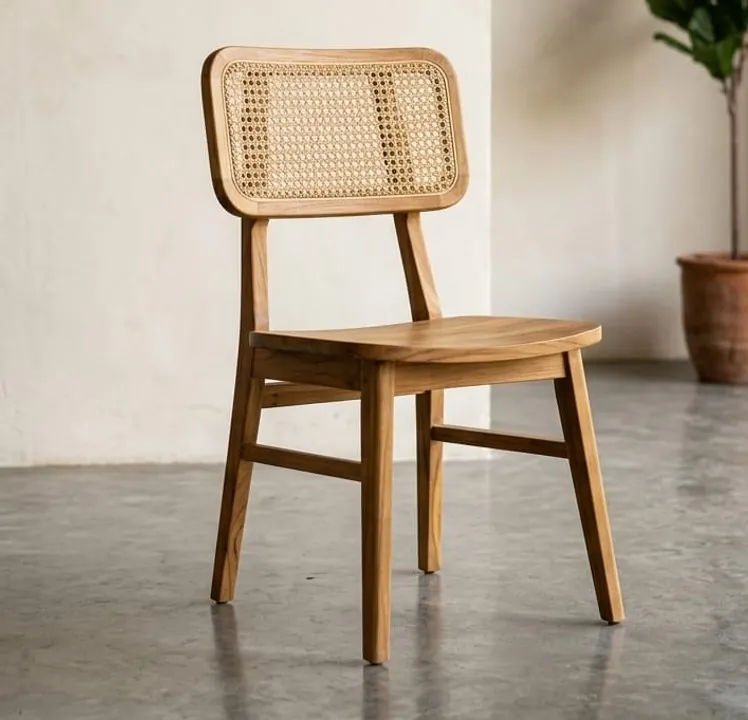
- Look for stretchers between chair legs. They share the load and protect the main joints.
- On cabinet doors, check that the panel can rattle very slightly in its frame. That means it floats and can move.
- Ask about the moisture content of the timber. Joints made from wet wood loosen as the wood dries. Our moisture content guide explains why.
What you can do at home
Keep furniture out of the direct blast of air conditioning, avoid moving pieces between closed cold rooms and open terraces, put glides under chair legs so they slide instead of being yanked, and tighten any loose bolts early. A wobble caught in the first weeks is a five minute fix. A wobble ignored for a season can split a leg.
These details are worth asking about for every piece you buy, including ours. If you want to talk through the joints on a specific design, send us a message on WhatsApp. For the wider picture, read the complete guide to custom teak furniture in Bali.

Albert Meigo founded Bali Teak House. He trained as an aerospace engineer at Institut Teknologi Bandung and works with simulations of heat, moisture and structural loads, which is why these guides talk about moisture content and joints, not only looks.