Short answer: no finish keeps teak looking new forever in Bali. Oil looks lovely but protects very little, clear varnish lasts about a year in full tropical sun, and raw teak simply turns grey without losing strength. The right choice depends on where the piece will stand, not on the label on the tin.
I trained as an engineer, so I wanted numbers rather than sales talk. This guide collects what published studies measured, several of them on teak grown in Indonesia, and turns it into a short plan you can follow.
Why teak is hard to coat
The same natural oils and resins that help teak resist water, rot and termites also fight the finish. A US Forest Service handbook on exterior finishing names teak, together with cypress and the cedars, as woods whose oils can slow the drying of a coating and leave it sticky.
A 2019 study in the journal Maderas measured this on Indonesian teak. Ten year old plantation sapwood from Bogor held 5.04% extractives, and 40 year old heartwood from Madiun held 9.79%, almost twice as much. The researchers then tested two coatings with a standard cross cut tape test:
| Coating | Area pulled off in the tape test |
|---|---|
| Solvent based alkyd | Less than 5% on all teak samples |
| Water based polyurethane, young teak | 35% to 65% |
| Water based polyurethane, old teak | 15% to 35% |
The water based coating also cracked and grew dark stains during weathering, and the authors concluded it was not suitable for outdoor use. In plain words: on teak, the type of coating matters more than the brand.
Surface preparation helps. A Costa Rican study wiped 15 year old teak with 90% alcohol and measured how a water drop spread on it. The contact angle fell from about 81° to about 38°, which means the surface became far easier to wet, and a finish that wets the wood well grips it better. Wiping teak with a solvent just before finishing is a small step that makes a real difference.
How much does oil really protect?
Teak oil, linseed oil and tung oil soak into the wood and bring out the grain. They do not form a skin on top, and that is the weakness. In a classic US Forest Products Laboratory test, finished wood was moved into very humid air, 90% relative humidity, and the researchers measured how much of the moisture uptake each finish blocked. Higher is better:
| Finish, three coats | After 1 day | After 7 days | After 14 days |
|---|---|---|---|
| Linseed oil | 33% | 2% | 0% |
| Tung oil | 52% | 6% | 2% |
| Nitrocellulose lacquer | 79% | 37% | 19% |
| Polyurethane varnish | 89% | 64% | 44% |
| Two component polyurethane | 94% | 81% | 66% |
| Paraffin wax, one brushed coat | 97% | 83% | 69% |
After two weeks of humid weather, which is any normal fortnight in Bali, three coats of linseed oil blocked nothing at all, and tung oil almost nothing. Oil is a beauty treatment, not a moisture barrier. That is fine indoors, because teak itself moves very little, as explained in our guide to teak moisture content.
Oil and mould in humid air
A 2017 study in the Journal of Wood Science tested oiled wood in a climate chamber at 27 °C and 92% relative humidity for 21 days, conditions very close to a Bali rainy season. Pure tung oil and a pine tar and linseed oil blend did not stop mould, and in some cases there was more mould than on the untreated wood. Only a commercial oil containing two fungicides reduced mould clearly.
The test used aspen and birch, not teak, so the exact numbers will differ. The lesson still holds: natural drying oils on their own are not mould protection. If you oil teak that lives outdoors or in a damp room, choose a product made for outdoor wood that states it contains a mould inhibitor, and keep the surface clean.
What sunlight does to each finish
Sunlight is the second enemy. Ultraviolet light reaches about 75 to 150 micrometres into the wood and breaks down lignin, the natural glue between the fibres. Rain washes the broken material away and leaves a pale layer that looks silver grey. A 2021 review in Polymers puts the loss of the surface at about 3 mm per century for hardwoods, so greying is slow surface wear, not rot. The same review notes that most clear coatings fail after about two years outdoors in temperate climates and after about one year in tropical ones.
A 2024 study in Materials put 13 year old plantation teak from Bogor in an accelerated weathering machine for 12 weeks of cycles of UV light, condensation and water spray. Linseed oil changed colour visibly from week 3. Tung oil and a linseed and tung blend held up to about week 6, and then changed quickly. A commercial oil based polyurethane changed least of all, and the authors recommended it for outdoor use.
Real sunshine gives a similar picture. A Polish study coated teak with six clear finishes, including polyurethane, nitrocellulose lacquer, shellac and wax, and left it facing west in direct sun for a year. Every coated sample turned noticeably darker. The uncoated teak changed the least. The finishes made the colour more even, but none of them stopped it changing.
What works best outdoors in Indonesia
A 2020 Indonesian study by researchers from IPB University left coated teak and pine outdoors for 24 weeks. Paint combined with a wood preservative, and paint combined with a water repellent, gave the best protection against mould, surface checking and cracking. Both kinds of teak, young and old, held up better than pine.
Clear finishes are a different matter. The same US handbook recommends water repellent preservatives for natural looking exterior wood: thin, penetrating products that contain a fungicide and a small amount of wax. The first application usually lasts one to two years on smooth wood, and once the surface has weathered evenly, later coats can last two to four years.
A simple finish plan for Bali
| Where the piece stands | Finish to choose | Upkeep |
|---|---|---|
| Air conditioned room | Teak oil, or a solvent based lacquer on tables wiped often | Oil again every 6 to 12 months, or when water stops beading |
| Open room or covered terrace | Penetrating outdoor sealer with a mould inhibitor, or raw teak | Wash and reseal about once a year |
| Full sun and rain | Raw teak, or a water repellent preservative | Wash a few times a year, reseal every 1 to 2 years if you want colour |
Three rules follow from the research:
- Do not use clear varnish in full sun. It cracks and peels within about a year, and then the whole surface has to be sanded back.
- Do not rely on plain oil outdoors. It blocks almost no moisture after a few days and can feed mould.
- Prepare the surface. Sand, remove the dust and wipe with a solvent such as alcohol just before you finish, and choose solvent based products over water based ones on teak.
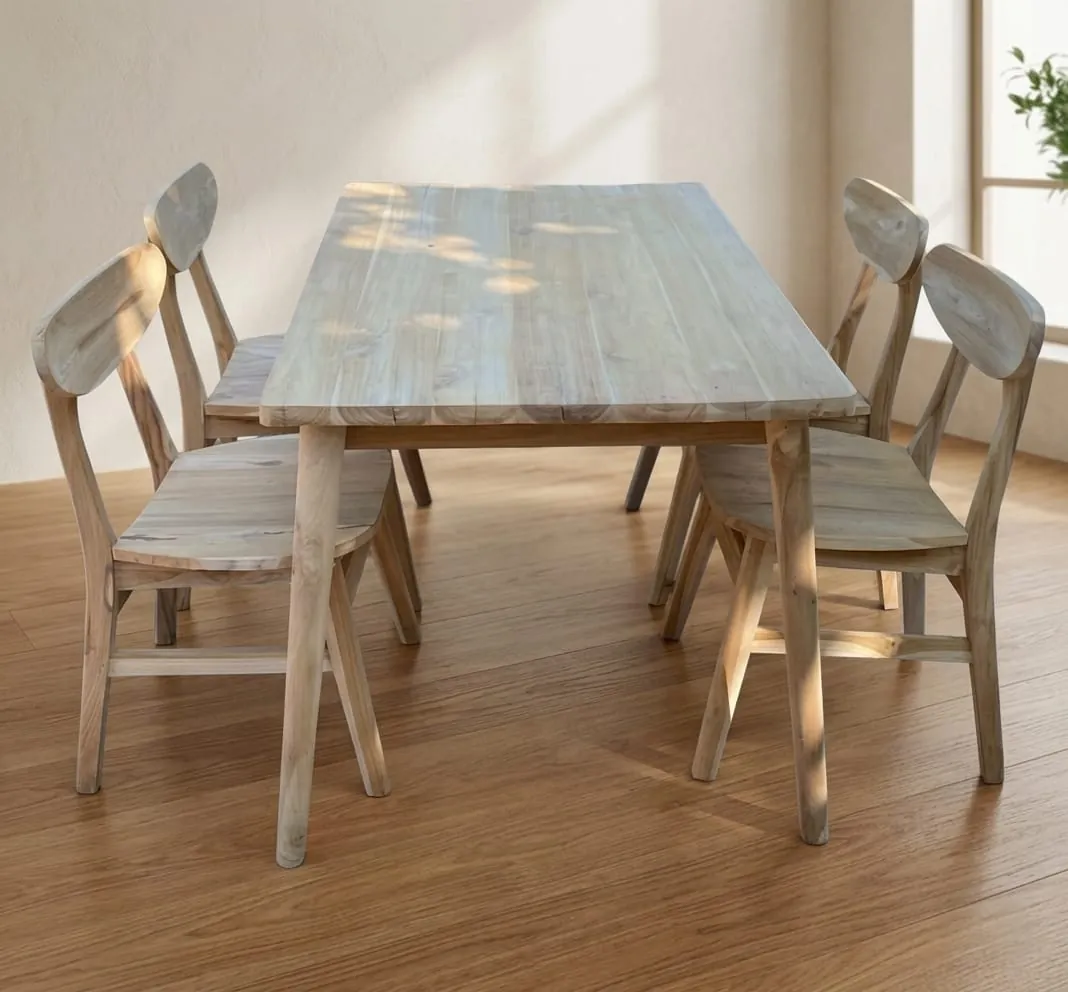
If you like the silver look, raw teak is the lowest effort choice of all. Our Raw Teak Dining Set is made to age that way. For why the colour changes and how to restore it, read why teak turns silver grey, and for room by room advice, see indoor vs outdoor teak finishes. Tell us where each piece will stand when you order, and we will suggest the finish.
Sources
- Pratiwi, L.A., Darmawan, W., Priadi, T., George, B., Merlin, A., Gérardin, C., Dumarçay, S., Gérardin, P. (2019). Characterization of thermally modified short and long rotation teaks and the effects on coatings performance. Maderas. Ciencia y Tecnología 21(2): 209 to 222. doi.org/10.4067/S0718-221X2019005000208
- Cassens, D.L., Feist, W.C. (1986). Finishing Wood Exteriors: Selection, Application, and Maintenance. Agriculture Handbook 647. USDA Forest Service. fpl.fs.usda.gov
- Garro Chavarría, M. (2009). Effect of alcohol and sodium hydroxide on the wettability of the surface of Tectona grandis wood (in Spanish). Kurú: Revista Forestal 6(17). revistas.tec.ac.cr
- Feist, W.C., Little, J.K., Wennesheimer, J.M. (1985). The Moisture-Excluding Effectiveness of Finishes on Wood Surfaces. Research Paper FPL 462. USDA Forest Products Laboratory. fpl.fs.usda.gov
- Ahmed, S.A., Morén, T., Sehlstedt-Persson, M., Blom, Å. (2017). Effect of oil impregnation on water repellency, dimensional stability and mold susceptibility of thermally modified European aspen and downy birch wood. Journal of Wood Science 63: 74 to 82. doi.org/10.1007/s10086-016-1595-y
- Jirouš-Rajković, V., Miklečić, J. (2021). Enhancing Weathering Resistance of Wood: A Review. Polymers 13(12): 1980. doi.org/10.3390/polym13121980
- Martha, R. et al. (2024). Surface characteristics and artificial weathering resistance of oil-based coatings on chemically and thermally modified short-rotation teak wood. Materials 17(15): 3881. doi.org/10.3390/ma17153881
- Jankowska, A., Szczęsna, M. (2011). The study of colour changes of chosen species of wood from South-East Asia caused by transparent coatings and exposure to sunlight. Drewno 54(185). yadda.icm.edu.pl
- Lestari, A.T., Nandika, D., Darmawan, W. (2020). Natural weathering on coated tropical woods. IOP Conference Series: Materials Science and Engineering. scholar.unram.ac.id

Albert Meigo founded Bali Teak House. He trained as an aerospace engineer at Institut Teknologi Bandung and works with simulations of heat, moisture and structural loads, which is why these guides talk about moisture content and joints, not only looks.